Most “how to see your aura” guides are just a list of steps with no explanation. That’s why most people try once and give up. The technique only makes sense when you understand what you’re actually doing — and honestly, it’s simpler than the crystal-shelf crowd makes it look.
Here’s the direct answer: you can see your own aura with a plain wall, soft light, and about 10 minutes. No equipment. No special talent. Just a specific way of looking that your eyes already know how to do — you’ve just never been told to try it. If you want the background on what an aura actually is, that guide goes deeper. This one is the practical method.
Can you really see your own aura? (honest answer first)
Yes. And I say that as someone who was skeptical enough to try it three separate times before it worked.
Your aura is the subtle energy field that practitioners describe as surrounding every living thing. In the Theosophical tradition, it has seven layers: etheric, emotional, mental, astral, etheric template, celestial, and causal. When beginners learn how to see auras for beginners, they’re catching the first one — the etheric body, the faint haze that hugs the skin.
This isn’t a new idea. The same concept appears as prana in Hindu tradition, as qi in Chinese medicine, and as the golden halos painted around saints in religious art across centuries. Different cultures, same observation: that living things give off something visible under the right conditions.
I’ll be honest about the frame. Treat aura-seeing as a practice in attention and self-reflection, not a lab result. But the technique itself is real, repeatable, and free.
What you need (nothing — seriously)
The aura seeing technique requires:
- A plain pale wall (white or off-white — busy wallpaper is the enemy)
- Soft, indirect light (not direct sun, not harsh overhead bulbs, not darkness)
- Your hand
- About 10 quiet minutes
That’s it. No crystals, no camera, no incense burning in the corner (though if you want to light one, I won’t judge — I have three going right now).
The soft-gaze technique, step by step
This is the method nearly every practitioner starts with. It costs nothing and works in any room with a pale wall.
- Stand or sit comfortably in front of your plain wall. Arm’s length away from it.
- Hold one hand up against the wall, fingers spread, palm facing you.
- Soften your gaze. Look at the wall just past your fingertips — not at the hand itself. Let your focus go slightly lazy, the way it does when you’re tired or daydreaming.
- Wait 30 to 60 seconds. Don’t strain. Don’t chase anything. A faint haze — clear, white, or grey — will usually appear at the edges of your fingers first.
- Stay with it. Once the haze steadies, a faint color may bloom around it. This is the moment.
- Don’t snap your eyes to it. The color lives in your peripheral vision. The moment you look directly, it often vanishes. Keep your focus parked on the wall.
Five minutes is plenty for one session. If nothing shows up, that’s normal on the first try. (More on that below.)
Why this technique works (the bit other guides skip)
Here’s a small, genuinely useful fact that most how to check your aura guides leave out: there’s a reason the color arrives in your peripheral vision first.
Your retina has two types of light receptors. The center (the fovea) is packed with cones — sharp, detail-focused, great for reading text. The edges are loaded with rods — more sensitive to subtle, low-contrast light and motion. When you soften your gaze and look past your hand, you’re essentially shifting the work to those edge receptors.
There’s also a phenomenon called Troxler fading: when you fix your gaze on a point, your brain gradually stops processing the unchanging background around it. The wall fades. The hand stays. And the subtle glow at the boundary — the thing your central vision was filtering out — becomes visible.
So the soft-gaze technique isn’t mystical. It’s a specific visual trick that uses how your eyes already work. You’re not summoning anything. You’re turning down the noise so the signal comes through.
What colors you might see — and what they mean
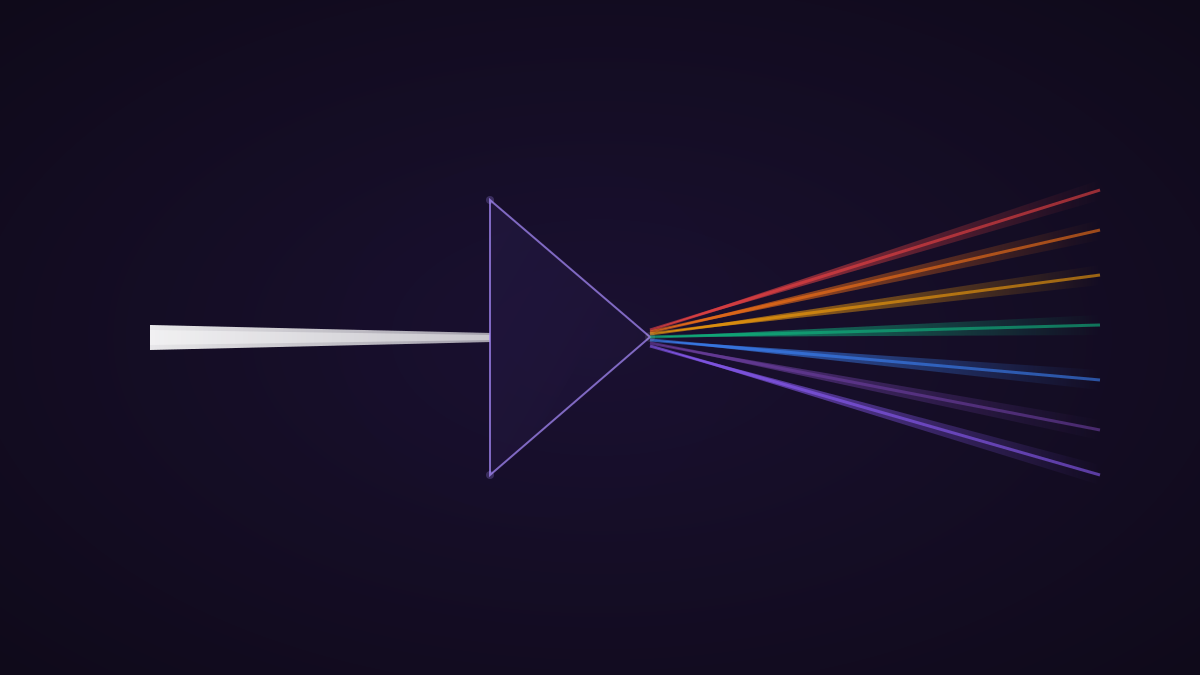
Once a color settles in, here’s what practitioners associate with each one. In the My Aura system, there are eight distinct aura types, each tied to a chakra and a solfeggio frequency:
| Color | Aura type | Chakra | What it suggests |
|---|---|---|---|
| Deep indigo/violet | Electric Indigo | Third Eye | Intuitive, reflective, old-soul depth |
| Dark blue | Midnight Blue | Throat | Calm, perceptive, communicative |
| Soft pink | Rose Quartz | Heart | Empathic, nurturing, emotionally open |
| Green | Sage Green | Root & Heart | Grounded, steady, in repair mode |
| Warm orange | Solar Orange | Sacral | Creative, sociable, running warm |
| Red | Crimson Red | Root | Driven, intense, action-oriented |
| Soft lavender | Lavender Mist | Crown | Dreamy, spiritual, creatively ethereal |
| Gold/amber | Ember Gold | Solar Plexus | Confident, warm-hearted, magnetic |
The shade you catch reflects your energy in that moment — your active aura — not a permanent label. Your baseline aura (the color that shows up most consistently) is more stable. The daily check-in on the site tracks how your active aura shifts over time.

Common problems and how to fix them
“I only see grey or white.” Good — that’s the etheric body, the first layer. Color comes with practice. You’re already seeing something real.
“The glow disappears when I look at it.” That’s Troxler fading working in reverse. Your central vision is sharp enough to override the subtle signal. Practice keeping your focus on the wall, not on the glow. Let it live at the edge.
“I don’t see anything at all.” Run the checklist: softer light, plainer wall, looser eyes, shorter session. Screens before you start are a common culprit — give your eyes 10 minutes off first. And drop the pressure. The harder you chase the glow, the faster it hides.
“The color keeps changing.” Normal. Your active aura shifts with your mood, your breath, your focus. The color you see most consistently over several sessions is your baseline.
“I tried once and gave up.” Most people do. One session is a sample of one. Give it five sessions over five days, 5 minutes each. That’s 25 minutes total. If you haven’t seen at least a faint haze by then, the technique genuinely might not be your path — and there are better options below.

Seeing other people’s auras
Once your own aura is visible to you, other people’s are often easier to see. The technique is the same — plain background, soft gaze, patience — but you’re looking past the outline of their head and shoulders instead of your hand.
Some people find it easier to start with others. When you’re not the subject, there’s less self-consciousness, and the target is larger. Ask a willing friend to sit against a plain wall, gaze slightly past the top of their head, and wait. The haze shows up around the crown first for most observers.
A note on how to read your aura versus someone else’s: your own is more emotionally loaded. You want it to mean something. With other people, you’re freer to just notice what’s there. That freedom actually helps the technique work.
If you can’t see your aura yet, try this instead
I’ll be honest: the soft-gaze technique doesn’t click for everyone, and that’s fine. Seeing an aura visually is one entry point, not the only one.
Aura photography is one alternative. It uses a Kirlian-style camera, first developed in 1939 by Semyon Kirlian, that maps electrical activity from your hands into colors on film. Sessions typically run $20 to $100 at wellness studios. A lovely keepsake, but it’s an interpretation — same as your eyes against a wall, just with a printout and a price tag.
The digital alternative is faster and free. The My Aura quiz identifies your energy pattern through gut reactions — seven rounds, 4 seconds each, under 30 seconds total. It reads your instinct instead of your retinas. You don’t need visual ability, and honestly, the quiz often identifies the same dominant color that the wall technique reveals after weeks of practice. Both are valid. Pick the one that fits your life.
The skeptic with a soft spot — the one who doesn’t “believe” in auras but tries the quiz on a whim and gets a description that lands — that person is my favourite reader. The technique isn’t about belief. It’s about paying attention.
Developing your aura sight over time
Like any perceptual skill, aura seeing gets clearer with practice. A few things that help:
- Short daily sessions beat long weekly ones. Five minutes a day for a week does more than one 45-minute session.
- Try different subjects. Plants, pets, your own reflection in a mirror with a plain wall behind you.
- Notice without naming. When a color shows up, resist the urge to immediately Google what it means. Sit with it first. The naming can come later.
- Track it. The daily check-in gives you a way to log what you’re sensing, even on days when the visual technique isn’t cooperating.
- Check your compatibility. Once you know your dominant color, seeing how it interacts with other people’s auras adds a layer of practical insight to your relationships.
Over time, some practitioners report seeing auras without the wall — against any background, in any light. That’s the advanced version. For now, the wall is your friend, the gaze is your tool, and the patience is the only thing you need to bring.